
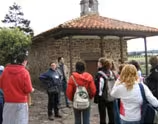
Located at Bo La Rebollada No 54, Guimarán. It is accessed from AS-19, Gijón-Avilés, P.K. 11,300, takes a private asphalted road to the right and, after driving around 300 m, arrives directly on the Fifth Clarin.
Leopoldo Alas ‘Clarín’ spent long seasons in Carreño. As a result of these summer stays in Guimarán, he became an observant observer of the life and landscape of this rural municipality and seaman, also marked by servitude and emigration to America. Meadows, peasants, chaplains, infanzoned families and Roman villages moved under their same names or other assumptions to the deadly pages of the clarinian narrative. The spirit of Leopoldo Alas and the shadow of Berta de Rendaliego still live in the Carreño valleys, which are ‘deaf from the rumours of the world’.
Solar of the García-Alas family, the Fifth was rebuilt by his son Adolfo in 1911 on the foundations of the old Casona or Palacio de los Lords de Alas.
It has three floors and an area of approximately 173 m². It is geared to midday, to the south, with a broad view of the Valle delimited by the historic Monte Arreo (Monte de las Aras), along which there was a small Roman road linking Lucus Asturum ¿(Llanera) with the famous Aras Sextianas de la Campa Torres, raised in honour of Emperor César Augusto.
Despite the changes, it still keeps the two-storey central house, with its old broker, stone chest with modernised altar and the stand over the viewer. In the past, a panera existed but when it collapsed, it was reconstructed as a hórreo by its current owners.
Since the middle of the 20th century, this house no longer belongs to the Alas family. The writer died, passed to his son and his son died at the hands of the daughter-in-law of Clarín. For economic reasons, the daughter-in-law had to leave the property and was taken over by José Sánchez Cima, who died. The current owner is his widow.
In front of the House, there is a small hood with the exterior carefully cared for from the time of the writer. This chapel dates from 1871 and is dedicated to the Purísima Concepción, preserved as in the Clarin era.
The hórreo was rebuilt in 1975 from a 6 packs of combs. It is a centuries-old hórreo with a cut door, on the front of which it is recalled that it was renovated in 1868, when Alas was 16 years old.
Is the dinner, a viewer with stairs and stone handrails built on the back, also kept, just above the handrail, raising the stand or Belvedere, which is a square floor, making a sort of brick miniature greenhouse with windows and door?
It was used by Clarín as a shelter where he reflected, read and wrote. Underneath the gaze a marble table, which did not meet Alas, the table was brought from Almería by his son Adolfo in 1920, when he was in that province as director of the company Mármoles Chercos ¿. Over time, the upper part has deteriorated and its current owners have changed it to another.