
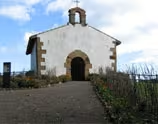
Ermita stands on the cliffs of the Punta del Cuerno de Candás, in the face of successive cliff collapses causing the cliff’s edge to reach only 60 MLC. After a stabilisation action on the cliff was ruled out due to its extraordinary technical and operational difficulty, in 2011 a stone dismantling was decided to a place close to but further away from the cliff in order to prevent it from being dragged down by the constant landslides in the area.
Work is currently under way to reconstruct the hood in a safer location.
Although stylistically the San Antonio chapel has been classified for years as a popular renacentist work, erected in the second half of the sixteenth century (as advocated by historians Juan Carlos Soto Boullosa and Pilar García Cuetos), the chronology of the building has been delayed until 1615, as a result of the ortho-photographic sweep carried out in 2011, prior to the disassembly of the chapel in which an inscription with that date has been found at the head of the ermita.
The San Antonio chapel is included in the urban planning catalogue of the municipality of Carreño, with a level of comprehensive protection, reserved for those buildings whose loss would result in a significant reduction in the architectural heritage.
From its location, it is dominated by a small outflow called ‘Punta beneath the Santo or San Antonio’, a place which witnessed deaths and mutilations during the Spanish Civil War. It is home to the image of San Antonio, a saint protecting lovers and noviazgos, a patron of pilgrims and a lawyer for lost causes. The Holy Festival was celebrated on 13 June, with religious events in the Ermita and a JIRA close to it with an auction of the Ramu, distribution of the preñao bollu and wine bottle, and as a collophon, an exhibition of Danza Prima was held by the seamen in the evening.