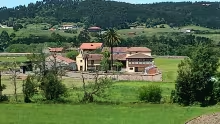
Located at Bo Palacio No 3 in El Valle, it is accessed from AS-19, Gijón-Avilés, P.K. 11,500, rotates to the left by taking the EC-5 road and at 2.500 m. The left is marked by El Palacio on its northern side.
It is now known as Casa Bárcena and is owned by Ramón Suárez Cuervo. That Palace is said to have been owned by the Condesa de Revillagigedo, which, according to history, travelled from his possessions in Pravia to Gijón, always and at all times on land belonging to him. The Palace was a ‘Cordon and Boiler House’, as it provided accommodation and food for travellers, had a pension and knight.
During the Civil War, he became HQ of the Republic, as he was next to Campo de Aviación de Carreño. Subsequently, as the dispute progressed, the National Bank was installed.
After the Civil War, the Palace became the property of the Díaz-Caneja, living in what are now the stables, the homemakers, the Suarez family, who have been the current owners since 1947. The main entrance is south-facing, through which the Camino de Santiago or Real passes.
The building dates from the eighteenth century, or even earlier, as its owners claim to have found a piece of wood bearing the date 1718.
It has two floors and currently U-shaped, as the original building was L-shaped, the gantry is supported by columns. It has a barrel, covered with half a barrel. This erupts, which is dedicated to Ntra. Ms del Carmen (whose first image was burnt in the courtyard of the Palais during the war confrontation) currently keeps two religious figures, one from San Antonio and the other from the size of the Virgin, both of which were given by the parish parish of El Valle for about 15 years, Don Teodoro, who was a prisoner at the Palais for two years. In the 1940s, the capilla was used to host some religious professions and was used at family-related ceremonies until very recently.
The dimensions of the Palais are so significant that one of its wings remains uninhabited. It consists of around five huge rooms and a corridor or quarter connecting with the hood.
In the centre of the building, there is a kind of torreón, known in the village as the ‘planchador’, as this was the essential service provided to ‘the ladies’. The Palais has many other premises and facilities, such as a craft water well and a compartment attached to the building which carried out the tasks of a tobacco drying house and, more recently, a house.
It appears that this type of crop was formerly common in Carreño and on the property the leaves of a kind of metallic infrastructure were hung, which it gave to the main entrance and which was originally a landscaped arch.