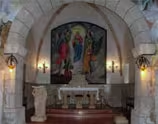
Located on the mid-slope of the Loma Cortina, in the Posada district, it is accessed by a branch from the right bank of the AS-19, Gijón-Avilés, P.K. 13 road leading to the Posada district. After circulating about 200 metres in the ascending direction, we found that church.
The building is made up of the Church and, next to it, the Rectoral House, situated to the south and separated by approximately 10 metres, is an Altar.
It was probably built in the 12th century, this temple underwent a first modification in the 16th century, with the construction of the Capilla Mayor which replaced the original ábside, from which a window was replenished, which is now located in the southern wall of the Capilla Mayor.
This window consists of a half point arc, supported on two columns. The arquivolta is decorated with geometrical motifs (saw teeth, semi-circles) as well as imposts (linked semi-circles). The captains of the columns are decorated with faunistic and plant-based motifs. Of particular interest are the reasons given in the captain of the left-hand column, which depicts four intertwined serpentiformes. On each side of the captain, the composition is made by associating the reptiles in pairs in such a way that the tail of one is bitten by the other and vice versa. The tendency towards abstraction and linear decorativism of the Logrezana Captain recalls similar themes of vikingo art.
The ensemble underwent a reform in 1875, and in 1936 (during the Spanish Civil War) it suffered damage and burned content. The church was reconstructed in the 1940s, thanks to money sent by Asturian emigrants residing in Cuba. At this time, the house was covered with a boveda nose, which collapses a few years later. In the 1970s, a forging was placed in the house, placing the fences and the cover on the start of the collapsed vault.
In these years, too, the gantry, which is neo-Roman and naïf style, is now attached to the western façade of the temple.
Templo has a window of the pre-Romanic Astur. The cover is made up of a half point arc, ploughed with zig-zag geometrical themes and stubborned decks supported by two smooth-walled columns on two bases.
Its general condition is acceptable, with damp conditions possibly due to the fact that this settlement is below ground level in some parts.
Clarín attended this temple in his youth accompanied by his mother Leocadia, and later frequented the church with his wife Onofre.
The Santísimo Sacramento festivities take place on the 2th Sunday after Corpus Cristi and on the first Sunday in October after Our Lady of Rosario.