
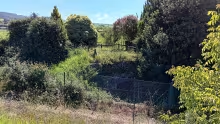
Continuous-running boiler with medium dimensions. It is located on the CE – 5 road at the exit of the El Cueto neighbourhood in El Valle in the direction of Guimarán, on the left bank of the road, close to the signal indicating the name of the neighbourhood, where the road begins to climb up to save the tracks of the train. The oven is protected by a metal wire rod and displays a plate explaining the lime process. It is included in P.G.O.U.
It has a cubic structure and its (raised) body fits into the steep slope of the terrain. Similar to other examples in the municipality, it is a square plant, with body in the form of an inverted cone and a slightly alomised load-bearing scraper, open with a circular mouth on the upper (swimming) part recessed by about 90 cm, as it was originally at ground level. The slope or slope is approximately 3.00 m in diameter.
Its north-facing façade (road axis) is 5.60 m wide and 3.40 m high. At the bottom, the so-called front or discharge mouth is opened, consisting of a depressed (frosted) arc, which is 0.85 m high and 170 m wide, preceded by a masonry bow, which is 2.00 m deep, the bottom of which is the opening of the opening of the home (ashtrays) where the fuel was loaded, which is also formed by a depressed arc, which is 0.60 m wide and 0.75 m high.
Raised in masonry, the inner body is also of the same limestone material, worked with lime and sand mortar. The inner wall of the cone (belly) has the shape of an inverted cone and is rigged with red stone called ferrial or grain. The arc of the home’s mouth giving access to the grill is currently collapsing and the side ramp has been replaced by a staircase.
García López del Vallado says that there were a large number of remarkable, medium-sized lime kilns in Carreño, all of which follow the same prototype: A circular swimming bug, in the form of an inverted cone trunk lined with stone (not brick liner) and which some operated until the 1950s. From the fuel it says that: although there is evidence of the use of firewood, coal was certainly also used, as stated in its reports González Posada and Jovellanos. From this he tells us that his quality is among the most prominent examples of the municipality and that he was rebuilt as reported by its owners in 1818, which led him to believe that, on that date, work was carried out to convert him from an intermittent running oven to a running oven or continuous combustion.