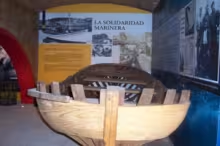
The Permanent Exhibition of the Candás Conservera Industry is also located in the same place, in what was formerly the mill of the canning plant.
1. The Sea and Marine Solidarity
Life at sea has always been dangerous. In Candás, historical tragedies such as the shipwrecks of local vessels prompted the creation of mutual support systems to protect fishers’ families:
- The fishing season: A pay-as-you-go system (the “brother-in-law”) that guaranteed income to the seafarer if he fell ill, or to his widow and children if he died.
- The Fishermen’s Association: Medieval institution offering luxury services for the time, such as own doctor and assistance to pensioners.
2. The Pescar Art
Three main methods have historically been used to catch fish:
- Gear: Use of hooks (such as longlines or traps for bonito).
- Networks: There are static, driftnet, purse seine (such as the ‘trolar’ in Candás) and trawl nets (the latter being prohibited in the Cantabrian Sea because of its damage to the ecosystem).
- Shellfishing: Use of pots and jigging equipment (known as ‘mafañeras’ in Candás) to catch octopus and other shellfish.
3. From Snow to Autoclave: Conservation
Before modern cans, millennial techniques such as ice, sun-drying, smoking, salting (famous salting sardines) and marinade were used.
The big leap happened when Nicolas Appert invented vacuum packaging in glass to feed the Napoleon armies. Later, the glass was replaced by the metal and the autoclave, a large pressure cooker sterilising the cans and still used today, was invented.
4. The Epoena Dorada de las Fábricas
Candás became a national reference, with 24 canning factories and a fish auction setting the price of fish for the whole of Spain. Industry was divided into two areas:
- The full workshop: It consists almost exclusively of women (and formerly girls). They carried out the manual work: clean, cook, cut and pack the fish. Their work depended on whether the vessels brought fishing on that day.
- The Vacuum Workshop: It was made up of specialised men who manufactured and repaired tinplate and wood containers.
5. Women: The Alma de la Conserva
Women were the engine of the factory. They went to work when a siren smiled warning of the arrival of the boats, no matter the time. Although they initially worked under very harsh conditions (11 hours standing, without uniform and with little stability), over time they obtained social rights and 8-hour days.
6. Decline and Presence of Industry
In the middle of the 20th century, industry in Candás began to decline for several reasons:
- The creation of large steel industries (such as Ensidesa) which pushed men away from fishing.
- The lack of depth in the port for modern industrial vessels.
- The relocation of large companies (such as Albo or Alfageme) to Vigo.
Nowadays, there are no more active factories in the centre of the town. Today’s industry has internationalised in search of cheap labour, although small businesses keep the tradition alive by focusing on artisanal production and the highest quality.