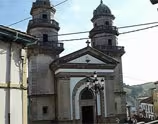
Church of San Félix de Candás
Situation between the streets Enrique ALAU Flórez, Los Cubos, La Escalinata Jesús García Prendes and Bernardo Alfageme, the latter coinciding with the AS-239 crossing, Luanco – Candás. The location of the Templo is signposted at several points in the population, coinciding with the entrances to the urban centre. The Church of San Félix dates from the tenth century and was donated by King Fruela II and his wife Queen Munila to Santa Catedral de Oviedo in 912. It is named after San Félix, in honour of a martyr of the same name as Gerona. It underwent a number of reforms in relation to its original construction, such as between 1620-22, an increase in the Temple, a new façade, the construction of the Tribal, vaults and arcs. In the 1734th century, a magnificent burrow-like retable was made, inspired by the Spanish Baroque. In 1740, it was golden, followed by the image of Santísimo Cristo de Candás, which was found about the first third of the sixteenth century by candacious fishermen on the Irish coast hunting whales and watching the image floating over marine waters. This retablet ended in 1749, as shown in the left pilastra inscription, which was carved by Esteban Fernández Perdones.
In the last third of the 18th century, various works were carried out, such as the high slaughter of ‘Camarín’ and the low slaughter of the Church. In 1811, the French troops in Gijón plunged the jewellery deposited in the Camarín del Cristo. Among what was stolen was a precious silver cross a gold warmer, a silver relicary with Santa Tecla bones, paintings by Francisco Bustamante and the overreliefs by Jesús and María de Gregorio Hernández. In 1875 and 1920 the Temple was further increased in order to receive the many devotes of the Santísimo Cristo de Candás.
In 1936, during the Spanish Civil War, the Church of San Félix de Candás was destroyed, as was the image of Santísimo Cristo (now a reproduction made in 1938) and almost all its contents. The Baroque retablet survived thanks to the intervention of the candastine sculptor Antón Rodríguez, who dismantled it with the help of the people imprisoned inside the church, keeping it in a warehouse. The content destroyed included the retablo Mayor of the 18th century; the baroque retables of the Nacimiento, Carmen, San Antonio and Pasión; various figures cut from the Conception, Cristo de la Vera Cruz, San Francisco, San Antonio and the Nazareno of the 18th century; the image of Saint Felix from the 18th century; The church tied to the column of the 18th century; The Chance of Descent of the 18th Century; and the Milagrosa of the twentieth century. Currently, there are some outstanding leftovers from old buildings, such as:
Inscription of the 16th century at the left entrance of the Templo, this is an Escaño del mayorentación Pedro Menéndez Valdés.
— Paintings of various subjects alluding to the history of the Concejo, made by Alfredo Menéndez, can be admired both in the coro and throughout the chapeau of the Christ.
— Remnants of the primitive 20th century church; it is a barrel hood with a Romanestic-style window behind the Altar Mayor.
One of the sidewalls depicts the Church of Column, which took place in the 13th century.
— On the upper floor is the Santuario, in addition to the paintings mentioned above, there is an image of the recent size of the Santísimo Cristo, which is on the 13th century Churrigueresco style retablet.
— On both sides of this grid, there are two doors leading to 13th century Caracol stairs, which give the aforementioned 10th century chest. These stairs were used by pilgrims to climb from knees to the Christ, so many of them rose there that their steps are heavily spent.
The festival of Candás patron, San Félix, takes place on 1 August and the Sardina Festival on the same day, declared a festival of regional tourist interest.
Originally the festival took place in the port, but since 2000 this festive event has been held in San Antonio, a much larger space that allows tasting with much more tranquillity both due to the breadth of the space, mentioned above, and due to the availability of green areas on the current site, which is much more convenient considering that sardines can be tasted ‘on the spot’ seated in the PRAO and used as the only hand cover. It is also possible to enjoy spectacular views of the Carreño and Gozón coastline from this new site of the festival.
On 14 September, the festival of the Santísimo Cristo de Candás, Patrono Mayor of all the Cofradías de Pescadores de Asturias (Fishermen’s Associations of Asturias) was celebrated, with this festival being the most important of those held in the village with a varied programme of events, including: La Alborada, held in the Alba on 14 September, Procesión del Sto. Christ at 11: 30 on the same day.