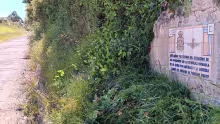
Located in the parish of El Valle. To access the site, it is recommended from AS-19, address Gijón-Avilés, P.K. 11,500, that the CE-5 road with direction Santa Eulalia del Valle be taken to the left, and that the ground track be taken from the right at P.K. 1, Camino de Ron, and that the commemorative plaque recalling the location of the Campo de Aviación de Carreño installed on 200-20-04, where the shelters were at the time, be found at approximately 97 m.
The practically non-existent facilities were used by the republican aviators during the Spanish Civil War and were considered at that time, in terms of both their strategic location and the number of vessels and their operability, to be one of the most important facilities in the entire northern strip of the Spanish Air Force peninsula.
The first head of this Campo was Hernández Franch, who currently lives in Barcelona. On the ceramic tiles, placed in the concrete ruins of one of those bunkers, it can be read "This place witnessed the heroism of the aviators of the Spanish Republic for their struggle for Asturias and freedom. Campo de Aviación de Carreño 1937-97’.
In Campo de Aviación de Carreño, of which a section of the runway, inserted into the outer perimeter of an industrial building belonging to the company LUALVA, is a sign, the dimensions of which are just over one and a half kilometres. It was grassy and also had the above-mentioned runway, made of a conglomerate (crushed stone) of 42 m by 600 m. It had a pair of concrete shelters and a wooden bow of 12 m, which served as a repair workshop, part store and assembly of aircraft.
In this field there were aircraft such as ‘Las Moscas’, ‘los Chatos’, ‘Folker’, ‘Dragón Rapide’ or ‘Breguet 19’. Their number, like that of pilots, varied and varied between 9 and 20 aircraft.
The construction of this Campo took place in record time, one month, with carts of stones drawn from neighbouring municipalities. It was operational until the end of the competition and remained operational from the end of August until 20 October 1937. There are no indicators to reach the area.